Physician Burnout
Recognizing the need to care for those that care for us

This is a weekly newsletter breaking down important topics in health and healthcare for the general reader.
To receive this newsletter in your inbox weekly, subscribe here 👇
It is very likely that you have heard the term job burnout before, a sense of emotional exhaustion, depersonalization, and reduced accomplishment stemming from one's job. While employees in every profession are prone to experiencing job burnout, the rate of prevalence among practicing physicians is alarmingly high and rising.
A 2018 survey found that 78% of physicians experienced burnout, an increase of 4% in two years. Burnout is not only bad for the physician, but can negatively affect patient care and the patient's health too. Due to that, finding the causes of, and addressing, physician burnout are very important for the future of health care.
Job Burnout
"Burnout" is not a medical diagnosis, but rather a work-related stress one can experience. However, medically diagnosable conditions, such as depression, can be part of the cause of burnout.
Some common causes of burnout include lack of control in the workplace, unclear job expectations, dysfunctional workplace dynamics, extremes of activity, a lack of social support, and a work-life imbalance. Burnout can be caused by one or a few of these causes, or an entirely different cause not listed.
There are also risk factors that contribute to an increased likelihood of experiencing burnout, such as having to work many hours, being in a helping profession, and identifying very strongly with one's work leading to a work-life imbalance. All of which many physicians experience as they are passionate about the work they do and are often made to work many hours.
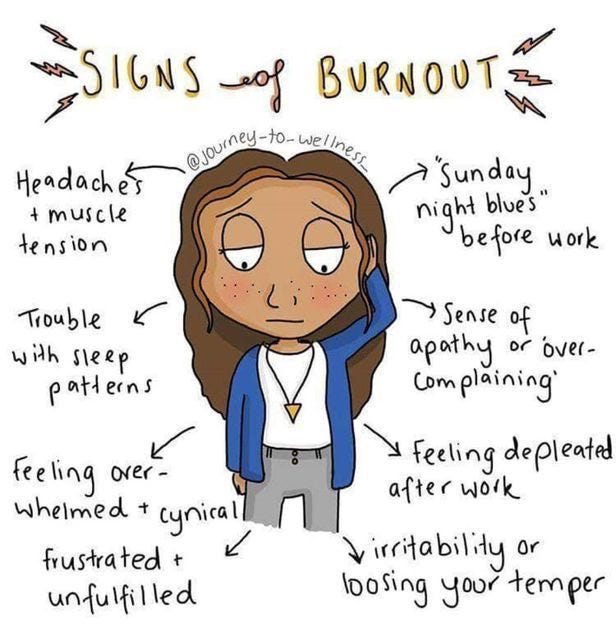
Generally, consequences of unaddressed burnout are excessive stress, fatigue, insomnia, sense of apathy, high blood pressure, and vulnerability to illness. Burnout has also been shown to decrease empathy and job performance which are crucial in the physician-patient relationship.
Physician Burnout
So now that we know what job burnout is, how is burnout manifested in the medical field? That depends on many factors, such as one's specialty, age, and gender which we will break down here.
Medscape conducts a National Physician Burnout & Suicide Report each year to look at these aspects and other contributors to the large proportion of burntout physicians. With over 15,000 physicians responding to the survey, this is what they found:
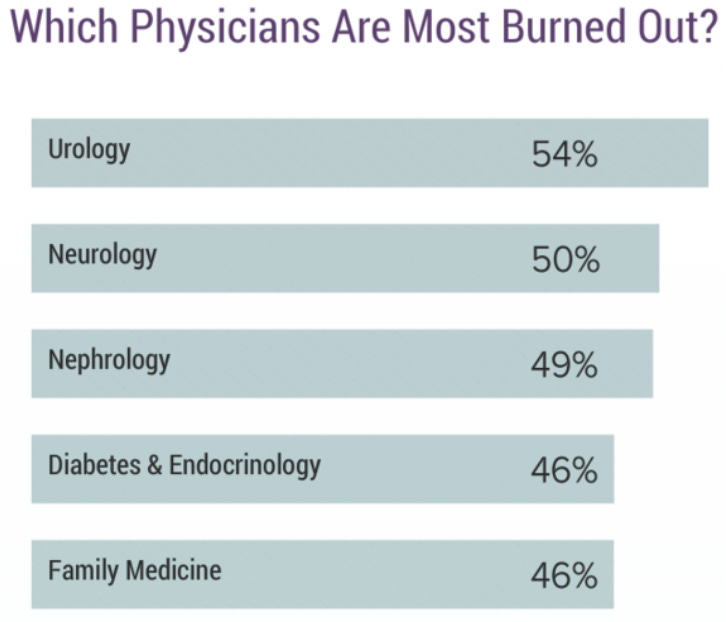
Specialty: The top specialties that experience burnout are urology, neurology, nephrology, diabetes & endocrinology, and family medicine.
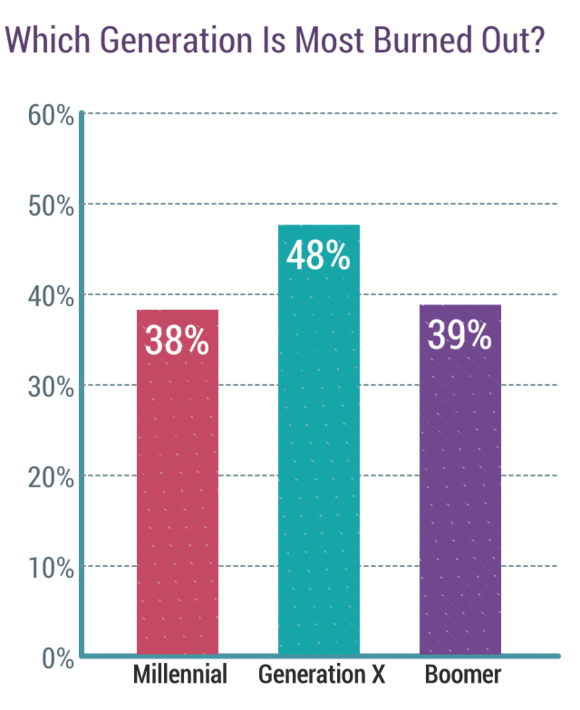
Age: Generation X physicians report noticeably more burnout than other groups. This is because mid-career is typically the time of highest burnout, and that is where Gen Xers are right now (40-54 year olds). They also have the added burden of role strain, usually having to juggle taking care of their kids and ageing parents with their work responsibilities.
Gender: Women physicians have reported higher percentages of burnout than male physicians, with 48% of women physicians compared to 37% of male physicians burntout. To explain the difference, Halee Fischer-Wright, MD, and CEO of the Medical Group Management Association said:
"Harvard Business Review published some pieces on the idea that women take on more work at work. They take on more 'non-promotable' work and they carry more of the weight in collaborative work. There are lots of reasons for this, but one is that they tend to care more about the collective, such as the well-being of their colleagues or the success of the business"
Overall, researchers at Stanford University School of Medicine found that about half of all physicians experience symptoms of exhaustion, cynicims, and feelings of reduced effectiveness. The study also found that burnout negatively influences quality of care, patient safety, turnover rates, and patient satisfaction. Previous work has also found that burnout and medical errors independently double the risk of suicidal thoughts among physicians.
Physician Suicide
The extremely high prevalence of physician burnout, contributes to the similarly high prevalence of physician suicides. One doctor dies by suicide in the U.S. every day, the highest suicide rate of any profession.
While already disproportionately higher than other professions, women physicians are at a higher risk than their male counterparts. Women physicians are 2.27 times more likely to die by suicide compared to woman non-physicians and male physicians 1.41 times more likely than male non-physicians.
What's interesting to note is that physicians who died by suicide were found to be less likely to be receiving mental health treatment than non-physicians who also died by suicide. This is due to a number of factors such as not wanting coworkers to know about their mental health, not wanting to pay for out-of-network costs if they see a physician outside of their network, or the idea that they are not as sick as their patients, so they do not need to seek help.
Blame it on the Culture
To address physician burnout and suicide, we must know what contributes to them. The top complaints from physicians is that there are too many bureaucratic tasks (charting, paperwork), they spend too many hours at work, and that there is a lack of respect from administrators, employers, colleagues, and staff.
Due to health care policy and insurance reimbursements, doctors are pressured or feel pressured to see as many patients they can a day, sometimes seeing upwards of 60 patients a day in an outpatient setting. The current system rewards speed over being thorough. This can even cause some physicians to save filling out paperwork until they get home as one physician wrote:
"I have to catch up with charting, even at home. I'm worrying about always being behind. The pressure from my employer about not seeing enough patients is very stressful. There's no work-life balance" - Gastroenterologist
Physicians are forced in a way to see many patients and confounded with the long hours contributes greatly to burnout. The issue of work-life imbalance is so important that49% of physicians said they would take a salary reduction in order to have a better work-life balance.
However, the issue of burnout often begins much earlier than a practicing, fully-licensed physician. Medical training in the U.S. encourages stoicism, teaching there is no room for error and to put the patient first, often leading to a physician's own detriment.
Stress and distress are normalized as part of being a physician from the earliest stages leading to medical students burning out in high numbers even before entering residency.
The fear of appearing vulnerable leads, many medical students and physicians to avoid asking for help, eventually contributing to burnout. A study of medical students found that they feel that seeking help for depression would make them feel less intelligent.
This toxic mentality held by the medical profession is what many physicians wind up victim too, while also often perpetuating that mentality themselves. 50% of physicians say their workplaces do not offer stress reduction programs. We know that burnout is a thing that is affecting many physicians, yet we refuse to offer the resources necessary to combat feelings of burnout.
The 80-hour-work-week limit
One of the aforementioned complaints that I want to go a little further into was spending too many hours at work. A heavily debated, reoccuring topic in medicine is the extent to how many hours residents should be working. Residents are doctors in training, medical school graduates training to become a specific type of doctor.
In 2003, amid concerns of fatigued doctors and patient safety, the Accreditation Council for Graduate Medical Education (ACGME) implemented rules limiting work hours for all residents to 80 hours a week and no more than 24 consecutive hours on duty.
This change led to concerns from physicians such as if residents will have enough experience, if they will be able to develop professionalism, and if medical training in the long run will be affected. One physician said:
"When I trained, good or bad, I worked about 120 hours a week. That was just expected. Today the average resident finishes with around 900 operative cases. I finished with twice as many" - Dr. Thomas Scalea, trauma surgeon and professor at the University of Maryland SOM in Baltimore
So, researchers at Harvard Medical School looked at the outcome of nearly 500,000 hospitalized patients comparing doctors who had residency training of 90-100 hours compared to those under 80, and found that the patients of the doctors with more training hours had no better outcomes, despite the additional hours in training.
The ideas of "I did it, so you have to do it" or that working many hours during residency is a sort of "rite of passage", does not actually improve the care provided to patients. They only harm the physician which in turn can negatively affect the care patients receive.
Changing the Culture
When looking to address physician burnout, most of the work will need to be done at the organizational level. A one-size-fits-all approach will not work to tackle burnout since each organization has their own specific cultures and areas of growth.
For example, Massachusetts General Hospital in Boston conducted a survey and identified 4 key areas to target: finding fixes for IT and electronic health records, governance, workflow, and wellness. With this information, they will be able to address the factors that most directly contribute to burnout in their health system.
Generally, reducing burnout involves managing triggers and addressing symptoms. This includes autonomy or control over one's work environment, camaraderie or relationships with colleagues, and engagement in purposeful or meaningful work.
In respect to the work environment, allowing physicians to curate the environment from the inside out will best set up an organization for success. Physicians, more so than healthcare executives, know best how health care works. So, by allowing physicians to dictate how the hospital runs, health organizations can avoid many of the logistic and administrative pitfalls commonly seen today.
The CNO and vice president of patient care services at a New Orleans-based hospital explains how his organization was able to do just that:
"We are a relatively new hospital, just four years old, so our physicians have been around to create their own environment and invite their friends to come practice with us. The hospital has become an attractive workplace for physicians because staff members are happy, and the administration supports them"
As stated earlier, much of the mentality and burden begins early on in medical education, so addressing burnout includes improving the situation in the stages of education. The Mayo Clinic School of Medicine has a program on well-being to teach strategies to their medical students, including:
Arranging visits with a mental health counselor for all matriculating students
Teaching stress management, resilience, and mindfulness skills
Subsidizing on-campus fitness center access for all students
Making assessments pass/fail during the pre-clinical years
Funding student-run wellness activities
With the implementation of their program, Mayo has seen a decrease in student distress by nearly half in just 3 academic years with the implementation of this program.
Fortunately, physician burnout has been getting more attention within, and outside of, the medical community. Healthcare organizations and medical schools have begun to address and implement programs in an effort to reduce the high number of physicians that report feeling burntout due to their work. While long term results of those programs are still unknown, one can hope that these measures will be bring about real change within the healthcare community.
Continued reading…
Could COVID-19 Pandemic Increase Physician Burnout, Suicide?
🏥 Weekly Rounds
🦠President Trump has been discharged from Walter Reed Medical Center and has returned to the White House where he tweeted a video saying, "one thing that's for certain: don't let it dominate you. Don't be afraid of it. You're going to beat it". On Tuesday morning after a check-up, President Trump's doctor said that "[President Trump] reports no symptoms".
🏅The 2020 Nobel Prize in Physiology or Medicine was awarded to three scientists who have discovered the Hepatitis C virus, responsible for cirrhosis and liver cancer in many people around the globe. Hepatitis A and B viruses have previously been discovered, but the majority of blood-borne hepatitis cases had no explanation, until the recent discovery.
🗣A study finds that face mask usage is unlikely to cause carbon dioxide poisoning due to CO2 trappage, which many people have claimed during the pandemic. From researcher Dr. Michael Campos, "we show that the effects are minimal at most even in people with very severe lung impairment".
🏛A House Oversight subcommittee has opened an investigation into whether White House officials unduly influenced government health agencies, specifically the Centers for Disease Control and Prevention and the Food and Drug Administration.
💉The Food and Drug Administration (FDA) has released updated COVID-19 vaccine safety standards on Tuesday after the White House blocked a formal release of the new standards. The FDA said vaccine makers should follow trial participants for at least two months to rule out safety issues before seeking emergency approval, which would prevent a vaccine from being released before the election as President Trump has repeatedly insisted could happen.
💨A Canadian company, Kontrol Energy, has developed a wall-mounted device it claims can detect the presence of COVID-19 in the air, and send an alert.
Thanks for reading! Click the button below to subscribe if you haven’t yet 👇